Ivan Horak · Supervisor: Dr Avinash Singh · University of Pretoria, COS700 (2026)
The finding in one sentence
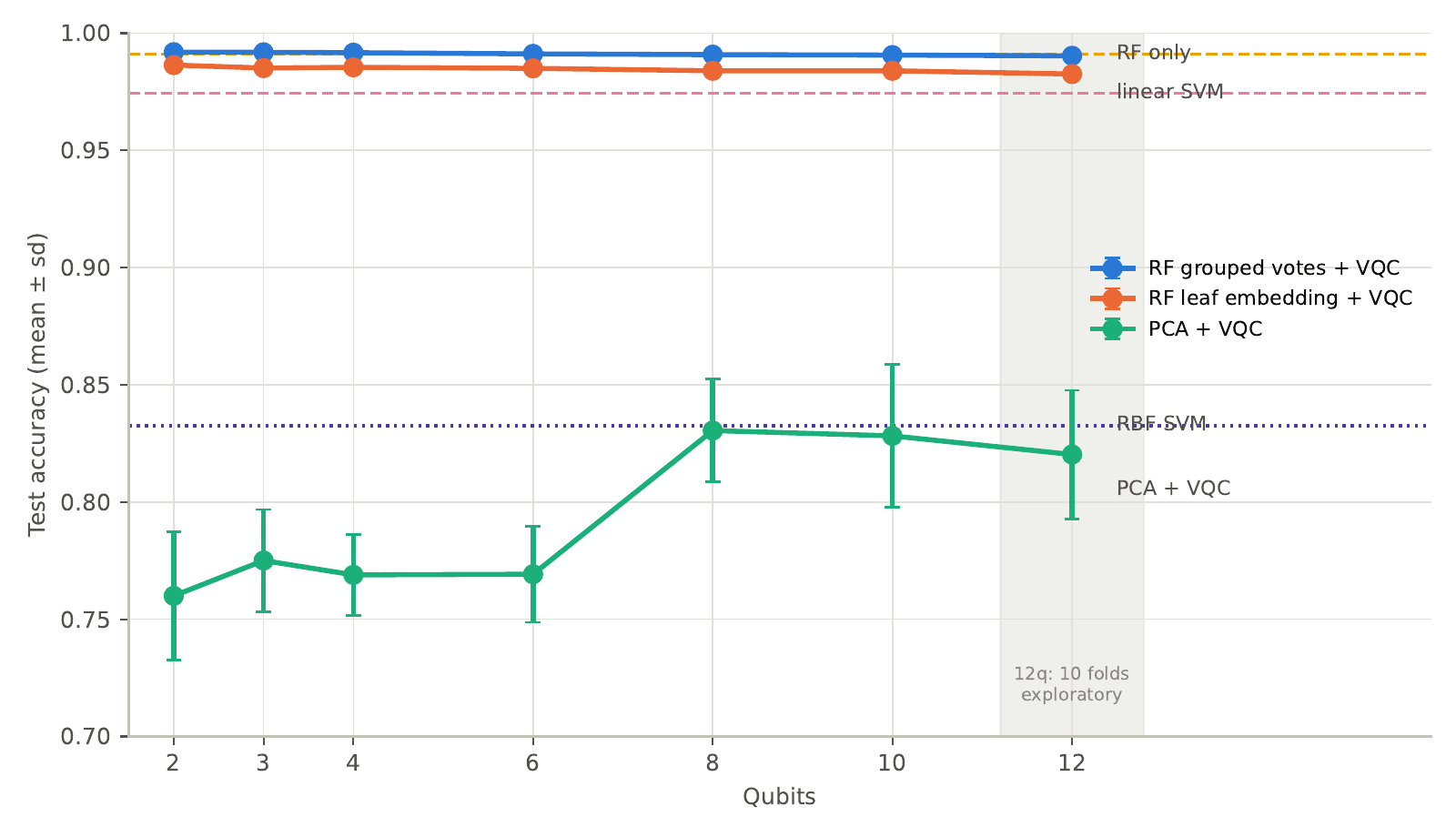 Test accuracy against qubit count for each arm, with classical reference
lines; 12 qubits is exploratory (10 folds).
| +0.23 | accuracy gain over PCA + VQC at 2 qubits |
| 50 / 50 | splits won by both RF arms at every qubit count |
| 0.992 | accuracy at 2 qubits; PCA’s best is 0.830 at 8 qubits |
What was done
Variational quantum classifiers (VQCs) can only encode as many features as they have qubits, and current hardware only offers a low number of qubits. Because of this, high-dimensional datasets, like datasets containing malware features, have to be reduced before they can be encoded. Generic techniques, like PCA, are usually used to perform that data reduction. PCA is used because it keeps the directions of most variance, but it does not take into account which features matter for classification. This leads to classification-critical information being discarded before the VQC ever sees the data.
This research asked whether a classical machine learning model, used as a pre-encoding feature reduction stage, could keep classification-critical information and improve the performance of a VQC on a high-dimensional malware dataset, compared to PCA, for the same number of qubits.
What it means
The bottleneck for a VQC on this dataset was the generic PCA reduction and not the VQC itself. Because the VQC matched the Random Forest by itself and did not improve on it, the gain came from replacing PCA and not from the quantum stage, so no quantum advantage is claimed. See Implications.
Where to go next
- New to this? Start with the problem, then qubits and VQCs, the qubit bottleneck and PCA versus a Random Forest.
- Know ML or QML? Go to the pipeline, results and limitations.