In short
The pipeline as first proposed would have shown almost nothing: PCA at chance and the Random Forest route at 0.79. Scaling the inputs fixed PCA; choosing the right encoding is what lifted the Random Forest routes to 0.99.
The ablation follows the experiments in order: the proposal’s spec, then input scaling, then a larger COBYLA budget, then model selection.
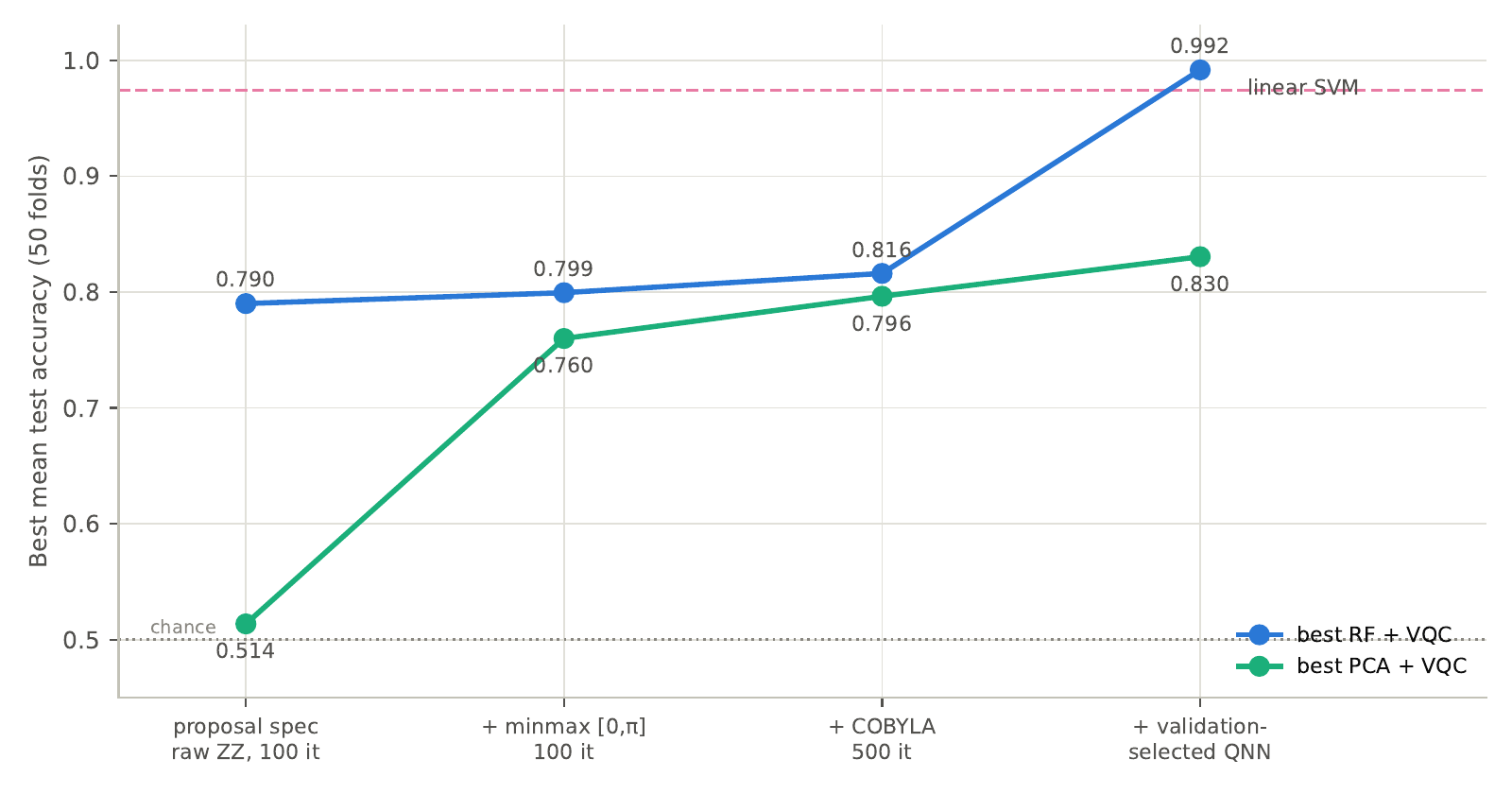 Best mean accuracy of PCA + VQC and RF + VQC after each change to the
pipeline. Stages 1–3 show the best of 24 configurations; the last stage uses
the validation-selected settings.
Scaling. At first raw values were used directly as angles, and PCA + VQC scored at chance, 0.50 to 0.51, below the 0.53 of always predicting benign. This is because large values wrap around the rotation, so different samples can look the same to the circuit. Just scaling to raised PCA by +0.25, while the RF routes went from 0.60–0.65 to 0.73–0.80.
COBYLA budget. With a limit of 100 iterations, COBYLA hit the limit for every fold, so every VQC was under-trained. With 500 iterations, following Thomos and Andronikos (2026), the 4-qubit models still hit the limit in 34–64% of the folds and the 8-qubit models almost always did. The larger budget gave +0.03 to +0.05 at 8 qubits and +0.00 to +0.03 at 4 qubits.
Before model selection. With ZZFeatureMap at 500 iterations, the leaf arm beat PCA by +0.020 at 4 qubits, but lost at 8 qubits (0.715–0.742 against 0.781–0.796). Top-k was not significant at 4 qubits and lost at 8, so it was dropped. Grouped votes, where every feature is a sub-forest’s mean malware probability and so carries signal, was added for model selection. Before model selection the RF advantage was small and held only at 4 qubits.
Model selection. After model selection the RF arms went from 0.816 to 0.992, a +0.18 increase, and PCA went from 0.796 to 0.830. The leaf arm alone shows the effect of the encoding: 0.816 with ZZFeatureMap and 0.985 with angle encoding, on the same route. The encoding has to suit the reduction method.
The two changes with the greatest impact were scaling (for PCA) and the choice of encoding (for RF). Model selection was done only on validation splits, so the jump could not come from tuning on the test data. The first three stages report the best of 24 configurations on the test splits and are slightly optimistic, so the true gain from model selection is, if anything, larger than shown.
Next: why it works