In short
Adding qubits did not help the Random Forest routes: they were already at about 0.99 with 2 qubits. PCA needed 8 qubits to reach its best, 0.830, and still fell well short.
This sweep covered 2, 3, 4, 6, 8 and 10 qubits on 50 splits, and 12 qubits on 10 splits. Each arm kept the same settings at every qubit count:
- PCA: ZZFeatureMap, 1 repetition, full entanglement and 4 ansatz repetitions
- Votes: angle encoding and 4 repetitions
- Leaf: angle encoding and 2 repetitions
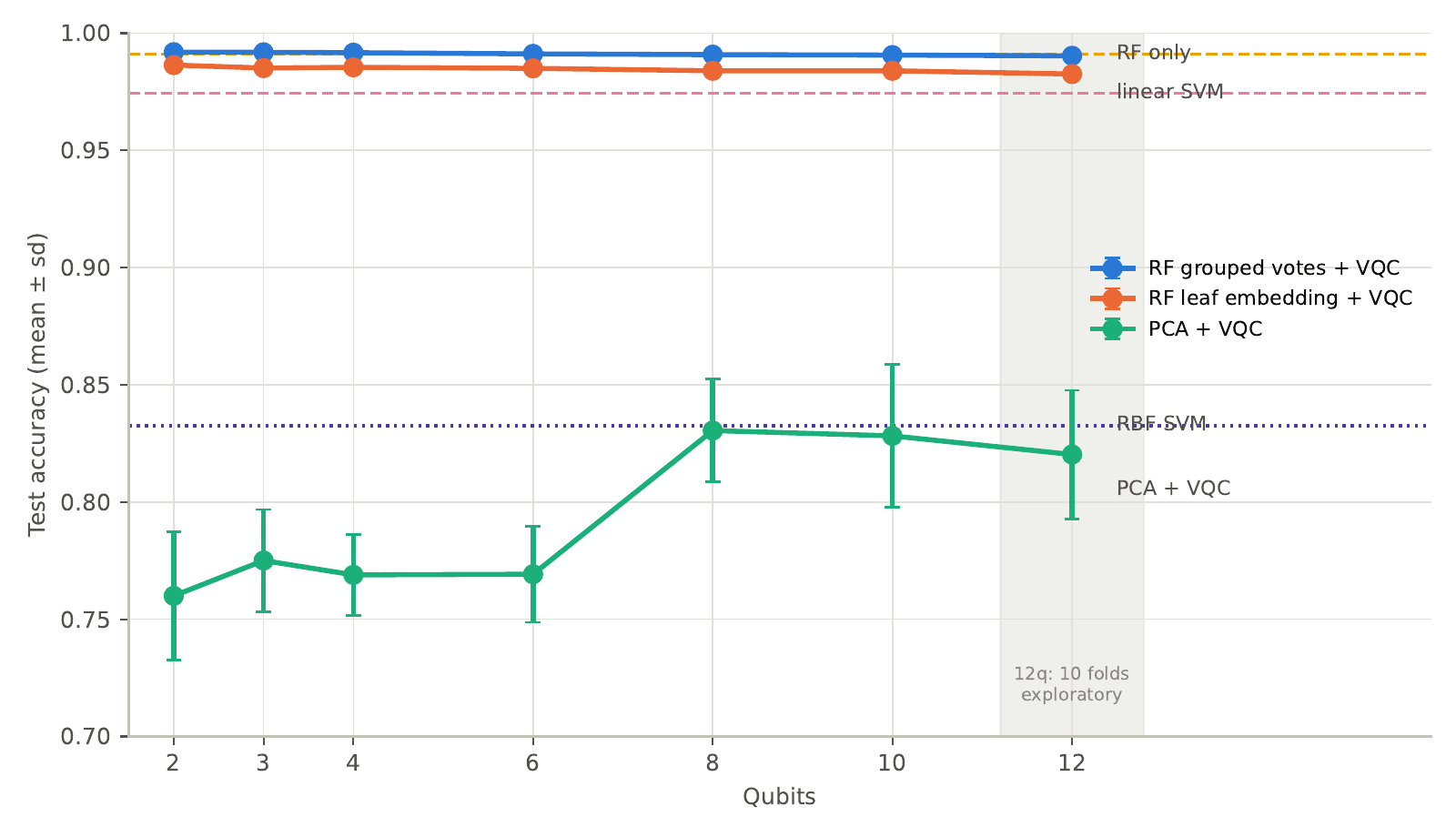 Test accuracy against qubit count for each arm, with classical reference
lines; 12 qubits is exploratory (10 folds).
Both RF arms’ trends are flat, with the votes arm staying between 0.990 and 0.992 and the leaf arm at 0.983–0.986 at every count, with a standard deviation of approximately 0.002. At 2 qubits the votes arm already reaches 0.992 and beats PCA at its best qubit count, 8 qubits (0.830), by 0.16, using only a quarter of the qubits. From 2 to 12 qubits both RF arms drop slightly (0.002 for votes, 0.004 for leaf), so extra qubits do not increase performance.
The PCA arm did not rise steadily with more qubits. It rises from 0.760 at 2 qubits to 0.775 at 3, stays flat at 0.769 for 4 and 6, jumps to 0.830 at 8 and then eases to 0.828 and 0.820 at 10 and 12 qubits. Its standard deviation of 0.017–0.030 is about 10 times larger than the RF arms’.
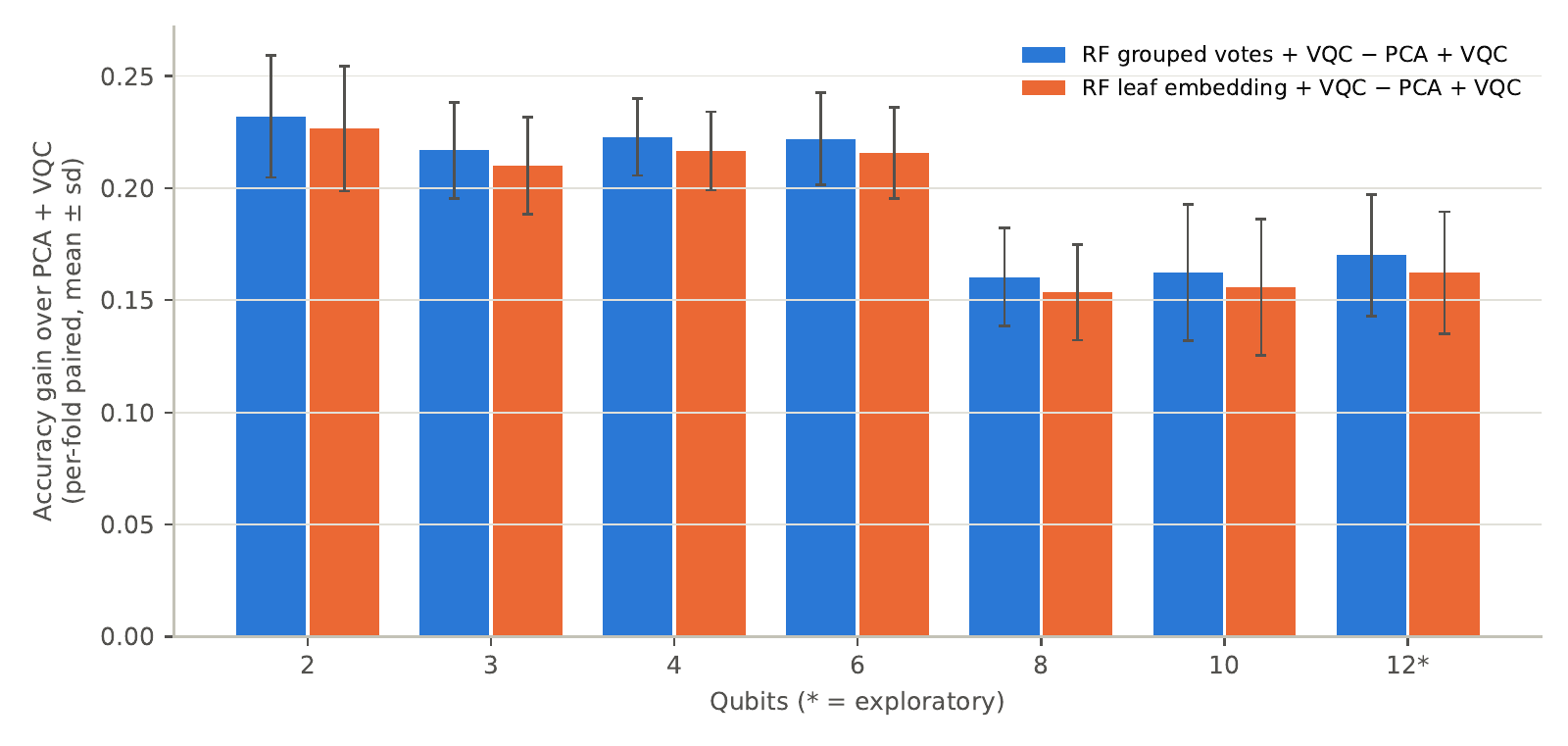 Per-fold paired accuracy gain of each RF arm over PCA + VQC at equal qubit
count.
The votes arm’s gain over PCA:
- 2 qubits: +0.232
- 3–6 qubits: +0.217 to +0.223
- 8–10 qubits: +0.160 to +0.162
- 12 qubits: +0.170
The leaf arm is approximately 0.006 lower than the votes arm at every qubit count. All 14 comparisons are significant on all five metrics after the Bonferroni correction. Both RF arms win all 50 of 50 splits, and 10 of 10 at 12 qubits. The gap shrank at 8 qubits only because PCA improved, not because the RF performance got worse.
The RF arms stay flat because the forest already compressed the signal into a few features, and 2 qubits were enough to carry it. PCA does not rise steadily even though it keeps more variance with each extra component. The COBYLA budget of 500 evaluations was reached for almost every fold from 3 qubits upwards, and the training loss rises with qubit count for every arm as the number of trainable parameters grows. Le et al. (2025) also found a similar non-monotonic trend for PCA + VQC.
Note
The PCA 4-qubit value here (0.769) differs from the 0.776 on RF versus PCA because this sweep used one fixed setting per arm, while the final runs used the validation-selected settings.